

We use cookies and similar technology to improve our website and customize content. By using our site, you agree to this use of browsing information. Read our policy for details.



Historically, the four seasons have been explored as a metaphor symbolic of the phases of all forms of life and represented across artistic disciplines including music, literature, fashion, and visual art. This exhibition, which is loosely inspired by Henry David Thoreau’s Walden, is a broader exploration of the relationship between nature and contemporary art.
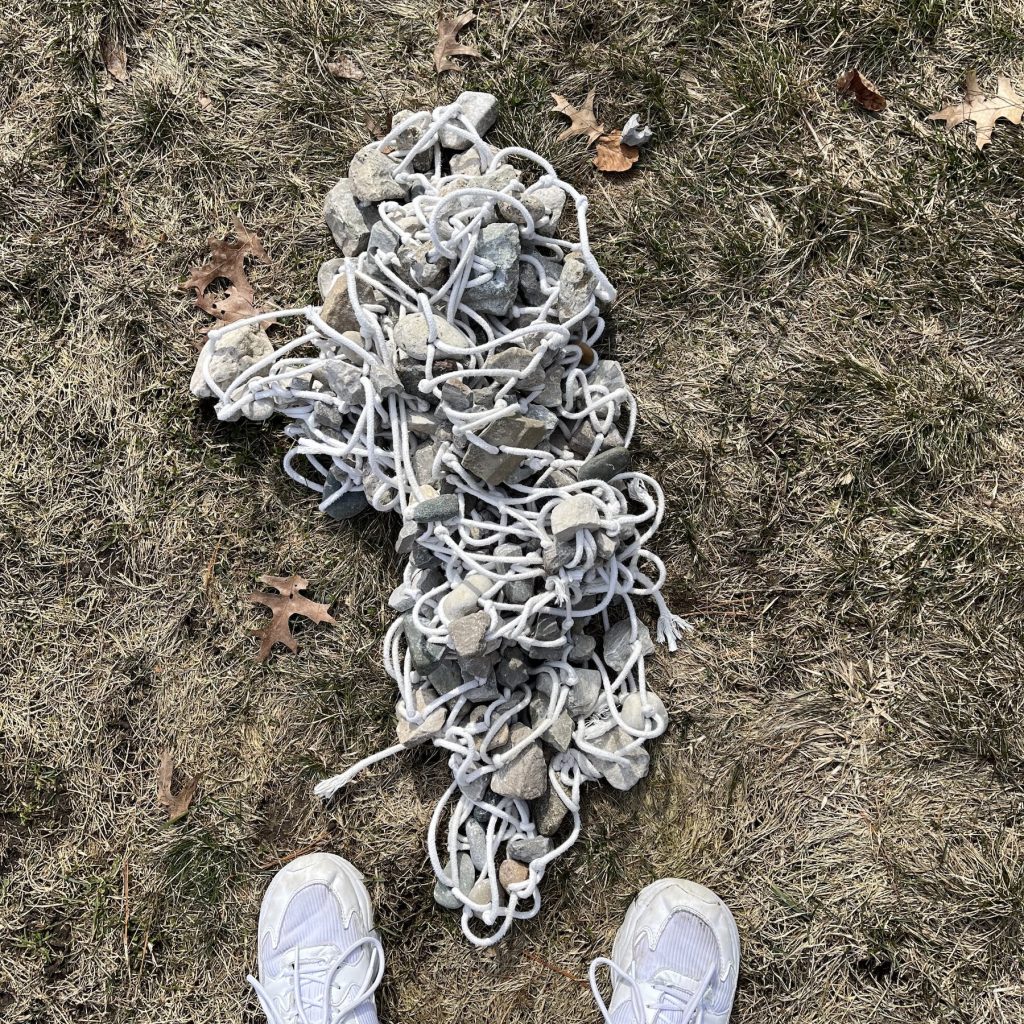
All Four Seasons in Equal Measure brings together six artists, all of whom live and work in Kentucky, whose works highlight their intimate relationship with place and the natural world. Their creative output celebrates the beauty of the environment and demonstrates their concern for its precarities through painting, works on paper, sculpture, video, and installation.
The exhibition continues on the second floor along with an activation that points to the history of this building as a library. A transitory space at the top of the rear stairs has been transformed into a reading room, populated with books recommended by the artists and copies of Walden.
All Four Seasons in Equal Measure was curated by guest curator Monique Long in collaboration with The Carnegie.
Artists: Britany Baker, Kiah Celeste, Shohei Katayama, Gibbs Rounsavall, Rachel Singel, Roy Taylor
Exhibition Run: September 26 – March 7, 2026
Opening Reception: Friday, September 26 from 5-8pm
Curator and Artist Walkthrough: Saturday, September 27 at noon

Monique Long lives and works in New York City. She is a writer and arts professional with an interdisciplinary practice. An independent curator of contemporary art, Long has organized exhibitions at institutions including Princeton University Art Museum, Portland Museum of Art, Guild Hall, Museum of the African Diaspora, the Institute of Contemporary Art, Philadelphia, and many others. Prior to working independently, Long held curatorial positions at The Studio Museum in Harlem and the Museum of Arts and Design. Long is also a critic who has contributed to publications widely on contemporary art and personal essays. Her most recent exhibition is on view at Mattress Factory in Pittsburgh.
The Edge Effect by Monique Long
….for my privacy, no house is visible from any place, but the hill-tops within a half a mile of my own. I have my own horizon, bounded by woods all to myself, a distant view of the railroad where it touches the pond on one hand and of the woodland road on the other, but for the most part, it is solitary where I live…¹
Walden by Henry David Thoreau
In 2021 I was invited by the director of the Great Meadows Foundation to be a critic-in-residence in Louisville, Kentucky where the foundation is headquartered. I was asked to meet with artists in the region and conduct studio visits during my time there. Intrigued by the opportunity to work outside of New York City, the town where I had devoted my entire career, and embed myself temporarily in another arts community relatively far away, I said yes.
For two months in early 2022, I found myself living in a two bedroom midcentury modern house that sat on a cliff not visible from the road. The house was surrounded by woods in New Albany, Indiana, a suburb just fifteen minutes from downtown Louisville. My job was to learn as much as I could about the local art scene and abide with the artists I was tasked to meet. Post quarantine, what would it mean to be extracted from the densely populated neighborhood where I lived in central Harlem and work in a completely different environment? How would it change my eye? I wouldn’t be living remotely exactly but it was a stark contrast from my normal life.
My beloved New York City smells horrible. Rodents are so aggressive there’s a position in the city government called ‘rat czar’ just to manage them. From the news reports it seems dangerous. And, moreover, it’s a wildly expensive place to live. Why do I love it? Because I can walk ten paces in any direction and encounter artistic expression: vibrant graffiti on the side of a building, a heartbreakingly talented singer performing on a subway platform, a public art installation, a centuries-old brownstone, a library, a museum. Moving to Louisville was not a retreat from the intensity of city life. Rather, I wanted to learn something about contemporary art that I had been missing as a provincial New Yorker.
The universe is wider than our views of it.
– Walden
During my time in-residence, I visited artists’ studios several times a week, attended openings and other art events, hosted and cooked for colleagues at the house. We discussed a broad range of concerns related to contemporary art: career building, process and making, Black lives, Black history, the art market — what it means to be an artist today.
When it came time to organize this exhibition, as the curator I wanted to be an interlocutor for what was unique to this region from my point of view and bring together a group of artists that wouldn’t have been otherwise.
I reflected upon all that I had observed. During that winter in Kentucky, I thought of Thoreau often and his epistomological treatise on the virtues of nature and isolation over city life. Walden is a book I hadn’t read since college but I somehow felt connected to the text and what had brought me to Louisville. Was my proximity to nature enhancing my creativity and intellectual life? I was struck by many things artists shared with me but most especially how passionately they spoke about climate change, sustainability, and how nature influenced their practices. The exhibition’s working title became “The Walden Project”; a meditation on how nature and concern for the environment featured prominently among contemporary artists in the area. Eventually, the concept for All Four Seasons in Equal Measure was born out of a conversation I had with Roy Taylor, one of the six artists whose work is included in the exhibition.
In ecology, there is a theory called the “edge effect.” A Google search defines it as the phenomenon occurring in the transitional zone between two distinct ecological communities (for example, a forest and a grassland) where the conditions are a blend of both environments. These “edge” areas often support a greater variety of plant and animal species than either of the neighboring ecosystems alone, creating a rich biodiversity. Culturally, it can refer to “the creativity arising from the interaction of distinct cultures, often called the cultural edge effect, where differences between groups foster new ideas. Artists are inspired by unique cultural combinations, leading to transformative creative output.”
My hope is that my time as critic had the same impact on the artists I came in contact with as theirs had on me. I’m grateful for the kindness I experienced during and after my time in Kentucky. In no particular order, I’d like to thank my friends and colleagues from the cultural edge: Alice, Amethyst, Natalie, Cletus, Kiah, Vian, Jed, John, Stan, Lindsey, Candyce and Kathryn, Joey, and Tyler.
Thanks most especially to Julien Robson, Director of the Great Meadows Foundation who invited me here. Last, thanks to Matt Distel who invited me to be guest curator at The Carnegie for this project and suggested I work with the artists I met with in 2022. And Sso-Rha Kang who shepherded my exhibition to the end.
¹ Thoreau, Henry David, et al. Survey of Walden Pond : From the Original Drawing by Henry D. Thoreau, 1846, in the Possession of the Concord Free Public Library. Charles E. Goodspeed and Co., 1954.
 All Four Seasons in Equal Measure is presented by DBL Law
PROGRAM SPONSORS
Programming for All Four Seasons in Equal Measure is supported by:
Jamie Markle and Paul Wesselmann
The Uday and Nandita Sheth Family Foundation
The Carnegie receives ongoing gallery support from:
FotoFocus
The Andy Warhol Foundation for the Visual Arts